Ensnaring the Moment: On the intersection of poetry and photography, edited by Leah Ollman, is a first-of-its-kind anthology. It gathers more than 100 poems, spanning from the late 19th century to the present, written in response to family pictures, news images, found photographs and more. The 112 poets reckoning with photography’s impact on individual and collective consciousness include Elizabeth Bishop, Victoria Chang, Lucille Clifton, Jack Gilbert, Jane Hirshfield, Ada Limón, Sharon Olds, W. S. Merwin, Adrienne Rich, James Tate and Ocean Vuong.
“The poems in this collection open doors to photography—front, side, back, trap,” writes Leah Ollman. “They offer a passage in and a tunnel through. They serve as verbal portals to the visual, where the visual itself is a portal to the past, to an unrecognized facet of the familiar, to the other and to the self.”
“A decade in the making, Ollman’s anthology is exceptional in its attentiveness to the innumerable psychological and philosophical implications of photographs caught and considered in the lens of poetry. Many of the poems are, in some way, meditations on the translation process—or development, we might say—of photographs into feeling and word.”
—Forrest Gander, poet and translator
Each poem in the book engages photography in a distinct way. Some poets adopt the medium’s vocabulary—aperture, shutter, exposure—reshaping it for their own needs. Other poems contest the truth assumed of photographs, questioning the accuracy of what is shown and the nature of what is omitted. Throughout, the collection reveals poems and photographs to possess striking affinities and many shared impulses: to contract time; distill experience; and preserve fleeting moments.
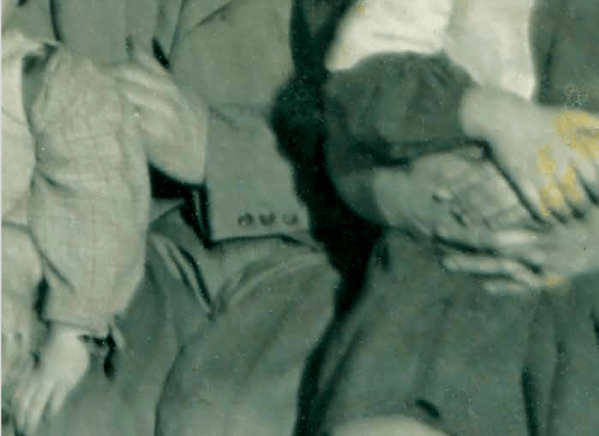
Family photographs are a recurring thread. In “Lasting,” Rae Armantrout observes, “When I remember my mother, I remember her fears./But in the photograph, she leans on a pillar/hands in pockets, head cocked,/slightly amused.” Other poets address missing images. Deborah Pope contrasts idealized family portraits with unmade photographs that reveal truer conditions of estrangement and silence.
“We framed the wish itself
and hung it up on the wall, where it looked
lifted from a book, the one that said
this is how we tried to look this is how
we want to be remembered
as those strange people stared back at us,
so fond, so artless, so unlikely.”
—from Formal Family Portraits by Deborah Pope
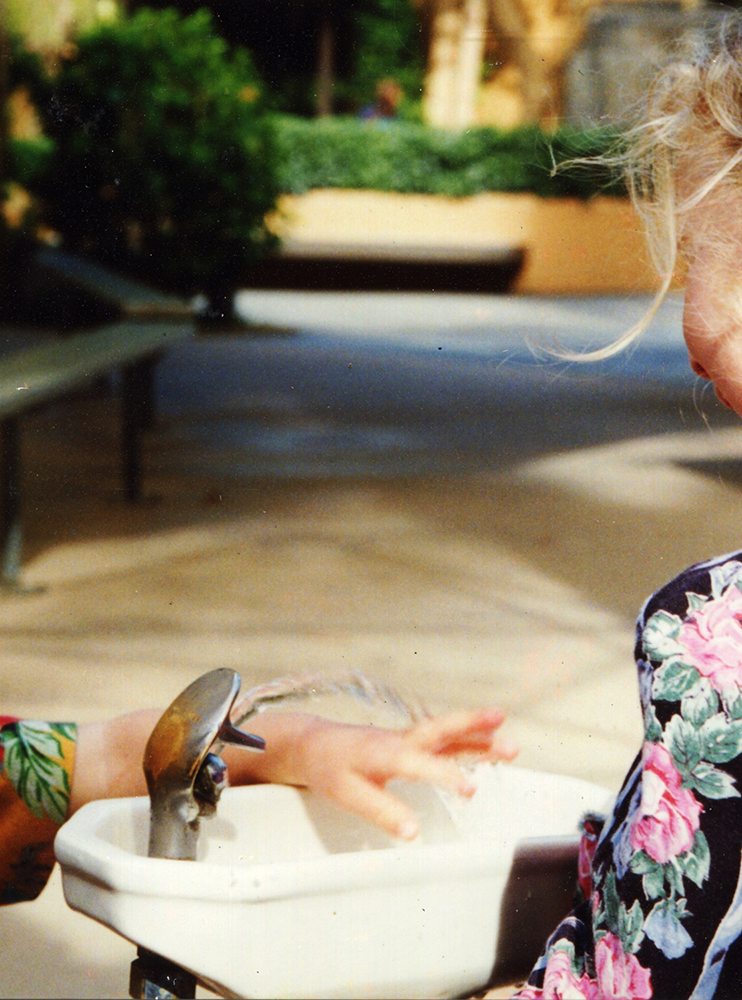
The book also addresses photographs beyond the personal. Junk shop snapshots, historical records, and news images all provoke responses. Many poems track an image’s journey from the public sphere into private consciousness. In one example, Kate Daniels evokes the iconic photograph from the Vietnam War of a child fleeing napalm without naming it: “She keeps on running, you know,/after the shutter of the camera/clicks. She’s running to us.”
In Elizabeth Bishop’s “In the Waiting Room,” the young Elizabeth flipping through National Geographic experiences a sudden realization of self. Ollman distills this moment into a question: “How can a photograph of someone so foreign to me reveal the truth of who I am, here, now?”
“…Poetry fishes us to find a world
part by part, as the photograph interrupts the flux
to give us time to see each thing separate and enough.”—from Beyond Pleasure by Jack Gilbert
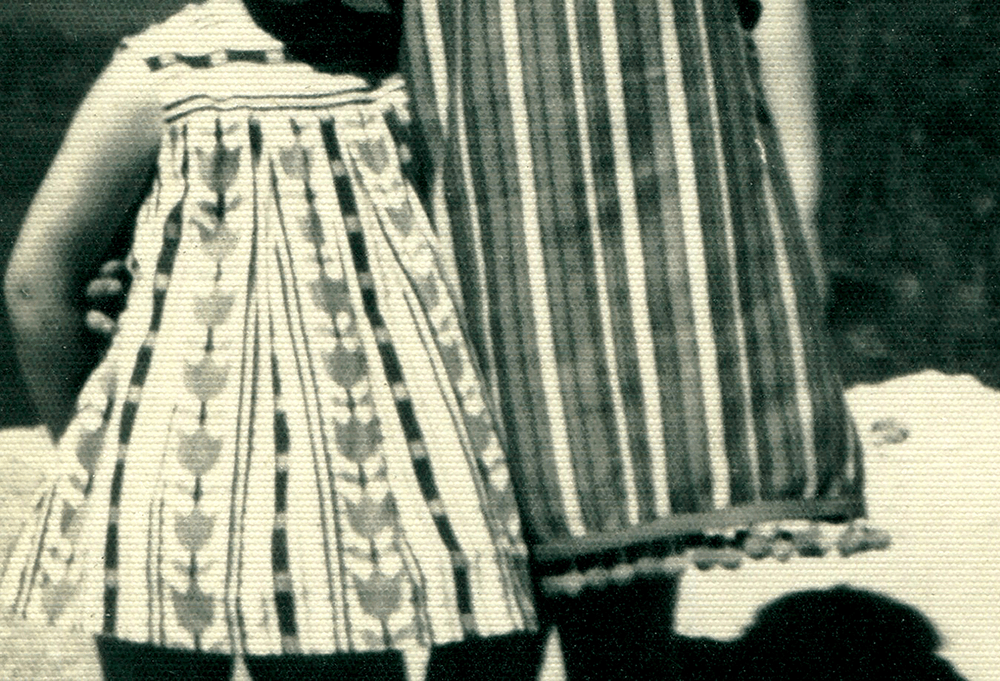
The collection also interrogates photography’s omissions. An Alfred Stieglitz image of laundry drying in the sun does not show the labor of the brown hands that made it possible. In “Ode to the Clothesline,” Kwame Dawes names that labor, foregrounding the hands that washed and mended. Rick Barot’s “Daguerreotypes” questions why antique stores hold no trace of entire communities, suggesting how exclusionary a practice photography has been in its history.
In her introduction, Ollman discusses ekphrasis, a Greek term meaning “to bring out, speak out, tell in full.” Originally referring to vivid, rhetorical discourse, ekphrasis now more commonly describes writing about visual art. However, the poems in this anthology use ekphrasis in its broadest sense, serving as unfettered acts of criticism and lyric forays into photo theory.
::
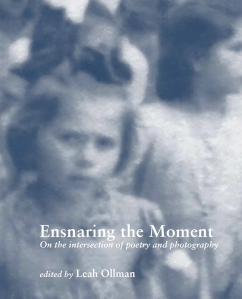
Ensnaring the Moment: On the intersection of poetry and photography
Edited by Leah Ollman
Book and cover design: Guenet Abraham
Published by Saint Lucy Books (May 2025)
ISBN 979-8-9899602-2-4
Hardcover
288 Pages, 9.5 × 7 inches
$40.00
All images: Private Collections, provided courtesy Saint Lucy Books
Leah Ollman is an art historian and critic based in Southern California. She has written extensively for the Los Angeles Times, Art in America, and Photograph, among other publications. Her essays and interviews have appeared in numerous books and exhibition catalogs, including Klea McKenna: Witness Mark; Chris McCaw: Into the Sun; Betye Saar: Serious Moonlight; Alison Rossiter: Expired Paper; William Kentridge: Weighing…and Wanting; Michal Chelbin: Strangely Familiar; and Julie Blackmon: Midwest Materials.
She curated the exhibitions, Camera as Weapon: Worker Photography Between the Wars, and Time, Mark, Memory: Ucross at Forty.
Saint Lucy Books was established in 2017 by artist and writer Mark Alice Durant. Our first book, Hidden Mother by Laura Larson, was shortlisted for the Aperture / Paris Photo Best Photobook of the Year. Since then, we have released 14 critically-acclaimed titles. Saint Lucy works on one book at a time; we value collaboration and respect to produce elegant, idiosyncratic, and accessible books that combine words and images to celebrate contemporary photographic artists, and to explore the marginal, hidden, and parallel histories of photography.
 Wobneb Magazine